
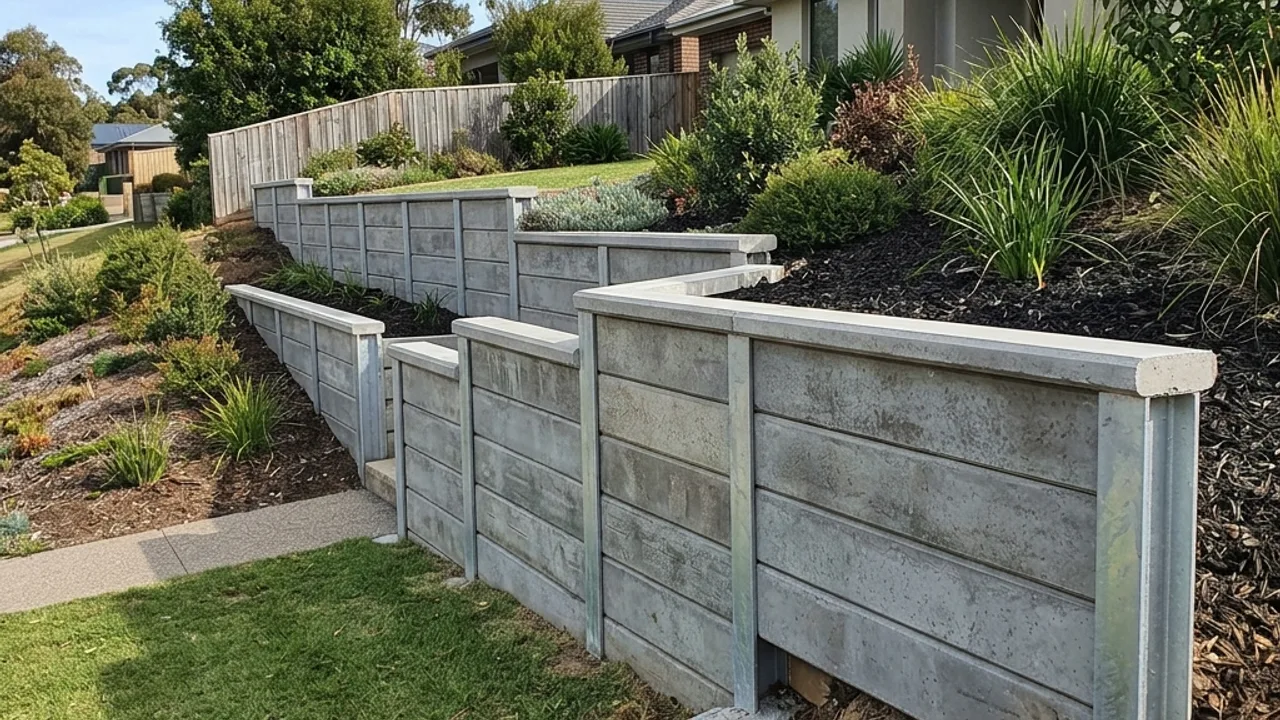
Concrete Sleeper Retaining Walls example in Newcastle NSW

Concrete Sleeper Retaining Walls

Steel-reinforced concrete sleepers set between galvanised H-posts - the workhorse wall for the sloping blocks across Newcastle's ridge suburbs.

Retaining walls Newcastle: what concrete sleeper retaining walls is

Concrete sleepers sit horizontally between galvanised steel H-posts driven or footed into the ground. It's the workhorse system across Newcastle's ridge suburbs because it handles taller, structural retaining without the maintenance timber needs and without the labour intensity of core-filled block.

Concrete Sleeper Retaining Walls in Newcastle: who it suits

This is the default recommendation for sloping blocks in Adamstown Heights, Charlestown and New Lambton Heights, where reactive clay over weathered Coal Measures bedrock means the wall is carrying real lateral load, not just holding back garden soil. It also suits driveway and boundary walls where a surcharge (a driveway or structure above the wall) pushes the job outside NSW exempt-development height.

Concrete Sleeper Retaining Walls: what's in scope

  • Galvanised H-post installation
  • Concrete sleeper supply and install
  • Capping and finishing

Choosing concrete sleeper retaining walls: the decision points

  • Retained height and whether anything above the wall adds a surcharge load
  • Post spacing and depth, set by an engineer once height exceeds the exempt-development standard
  • Capping and finish - exposed aggregate, smooth or a rendered face
  • Galvanising grade, worth checking within a few kilometres of the coast

Concrete Sleeper Retaining Walls cost in Newcastle

Concrete sleeper systems sit in the mid-to-upper part of the cost range for residential retaining, reflecting the steel posts, footings and heavier sleepers. Exact pricing depends on height, length, access and whether an engineer's design is triggered - a site visit is the only reliable way to price it. Use the cost calculator for a rough range, then get a site assessment for a real number.

Concrete Sleeper Retaining Walls vs the alternatives

Compared with timber sleeper walls, concrete costs more upfront but doesn't face the same rot and termite exposure, and it handles greater retained height. Compared with besser block, it's usually faster to install on an open site but less suited to a rendered finish on a tight inner-city block. See Timber sleeper retaining walls.

Drainage behind a concrete sleeper retaining walls

A concrete sleeper retaining walls still needs agricultural drain, gravel backfill and geotextile fabric behind it to actually last - see retaining wall drainage & subsoil systems for the detail.

Concrete Sleeper Retaining Walls across Newcastle

Pick your suburb for the local notes, or submit the form for a free review.

Concrete Sleeper Retaining Walls in Merewether Coastal blocks that fall from the Bluff and Scenic Drive down toward the beach, where dune sand sits over… Concrete Sleeper Retaining Walls in The Junction A tight inner-city grid sitting only a few metres above sea level, where the level changes are small but the… Concrete Sleeper Retaining Walls in Cooks Hill Terrace-house streets that step down from The Hill ridge onto old low-lying swamp ground, so drainage decides… Concrete Sleeper Retaining Walls in The Hill The escarpment directly above the city centre, where sandstone benching, heritage frontages and very old… Concrete Sleeper Retaining Walls in Hamilton Flat, low-lying ground behind Beaumont Street that started life as the Borehole coal township, so filled land… Concrete Sleeper Retaining Walls in Mayfield Land that falls from the Main Northern railway line down to the Hunter River flats, mixing old industrial… Concrete Sleeper Retaining Walls in Stockton A sand peninsula with dunes over 30 metres on the ocean side and marshland to the west, where low-cohesion… Concrete Sleeper Retaining Walls in Lambton Old Lambton Colliery ground around Lambton Park, where Lambton Ker-rai Creek, historic mine workings and… Concrete Sleeper Retaining Walls in New Lambton Heights The 105-metre ridge behind John Hunter Hospital and Blackbutt, the steepest residential ground in the inner… Concrete Sleeper Retaining Walls in Adamstown Heights Ridge-and-gully blocks around 64 metres up, where reactive clay over weathered Coal Measures gives long rear… Concrete Sleeper Retaining Walls in Kotara The flatter valley floor between the Heights ridges, where most retaining is modest rear-boundary cut and… Concrete Sleeper Retaining Walls in Wallsend Ironbark Creek floodplain wrapped around the old Wallsend and Plattsburg colliery townships, so overland flow… Concrete Sleeper Retaining Walls in Fletcher The newest ridge-country subdivision on the western edge of the city, where house pads were benched into the… Concrete Sleeper Retaining Walls in Charlestown At 116 metres the highest of the ring suburbs, on old South Waratah Colliery gully ground, where side and… Concrete Sleeper Retaining Walls in Warners Bay Lake-facing slopes running down to the Lake Macquarie foreshore, where terraced yards chase the view and the…

See all locations ->

Concrete Sleeper Retaining Walls - common questions

What type of retaining wall is best for a sloping block in Merewether?
Merewether’s steep blocks often need structural retaining systems such as concrete sleeper, block or engineered stone walls rather than simple garden edging. These materials cope better with the loads from driveways, houses and coastal soils. Good drainage and erosion control are essential because heavy rain can quickly wash fines out on a slope. Many local projects use stepped or terraced walls to manage height safely.
What retaining wall material gives the longest life in Newcastle’s climate?
In NSW conditions, reinforced concrete, concrete sleeper, masonry block and quality natural stone generally offer the longest service life for retaining walls. These materials resist rot, termites and constant moisture better than basic treated pine. With good drainage and construction, they can last many decades. Many Newcastle homeowners choose them for major level changes or walls close to homes and driveways.
How long should a timber sleeper retaining wall last?
Properly treated and installed pine or hardwood sleeper walls generally last many years, but they do have a shorter lifespan than concrete or stone. In NSW conditions they may give one to two decades of service if drainage and installation are done correctly. Constant moisture, poor backfill and lack of drainage greatly reduce their life. Many Newcastle homeowners choose concrete sleepers for longevity on more critical walls.

Talk to a specialist

Ready to talk about concrete sleeper retaining walls?

Free site assessment. No fixed price until we've seen your block.