
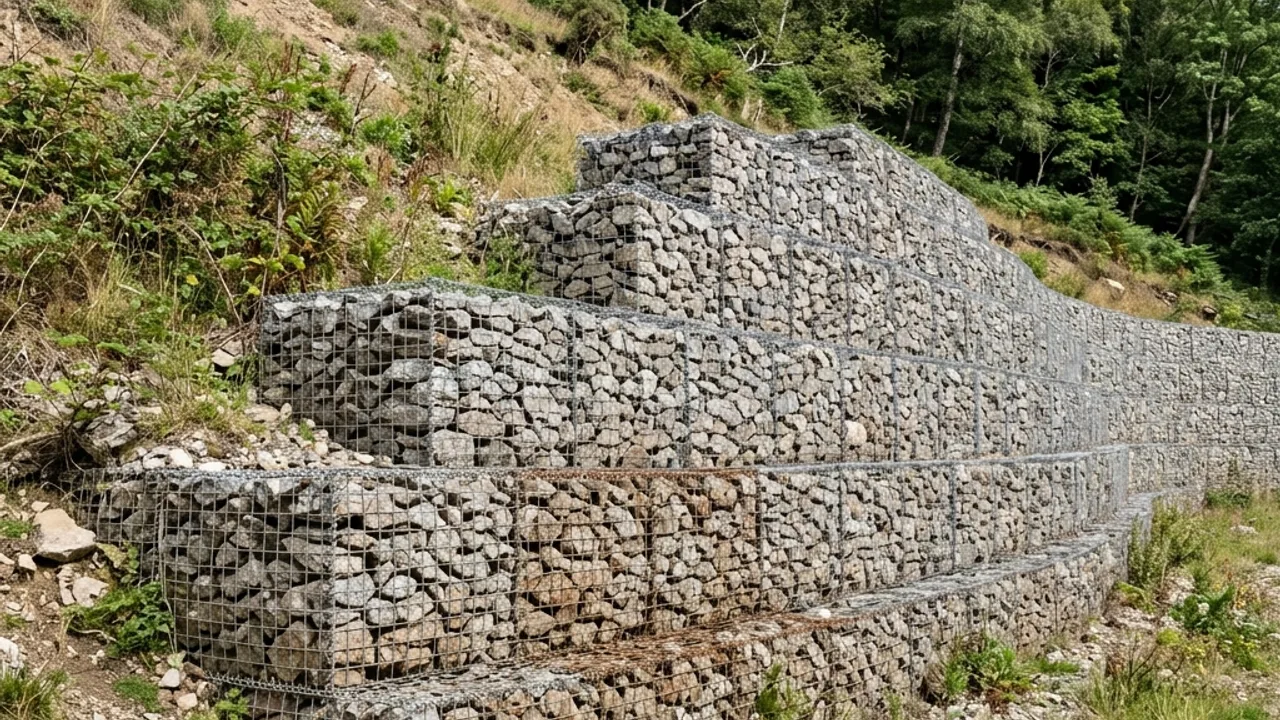
Gabion Retaining Walls example in Newcastle NSW

Gabion Retaining Walls

Rock-filled wire baskets that form a strong, free-draining wall suited to sloping and erosion-prone sites where surface water needs somewhere to go.

Retaining walls Newcastle: gabion retaining walls explained

Rock-filled galvanised wire baskets, stacked to form a free-draining, flexible retaining structure. Gabions handle ground movement and drainage differently to a solid wall - water moves through the structure rather than needing to be diverted around it.

Gabion Retaining Walls in Newcastle: who it suits

Erosion-prone and sloping sites suit gabion well, including Stockton's dune-sand blocks and Warners Bay's lake-facing slopes, where a free-draining structure that won't trap water behind it is a genuine advantage over a solid wall.

Gabion Retaining Walls: what's in scope

  • Gabion basket supply and fill
  • Erosion control walls
  • Coastal-grade coating selection

Choosing gabion retaining walls: the decision points

  • Basket size and wire gauge, matched to the retained height and load
  • Coating grade - galvanised versus PVC-coated, worth the upgrade within a few kilometres of the coast
  • Space required for the wall's thickness, which is greater than a solid wall of the same height
  • Rock fill source and size

Gabion Retaining Walls cost in Newcastle

Gabion walls sit in a comparable range to concrete sleeper for material and labour, though large-format rock fill and coastal-grade coating can push the price up. It's a specialist system rather than a mainstream default, which is reflected in fewer builders quoting it as a first option. Use the cost calculator for a rough range, then get a site assessment for a real number.

Gabion Retaining Walls vs the alternatives

Compared with a solid concrete or block wall, gabion is inherently free-draining and tolerant of some ground movement, at the cost of needing more space for the wall's footprint. It's a specialist choice, not a default - most Newcastle blocks are still better suited to concrete sleeper or timber. See Retaining wall drainage & subsoil systems.

Drainage behind gabion retaining walls

Even the best-built gabion retaining walls still need agricultural drain, gravel backfill and geotextile fabric behind them to actually last - see retaining wall drainage & subsoil systems for the detail.

Gabion Retaining Walls across Newcastle

Pick your suburb for the local notes, or submit the form for a free review.

Merewether Dune sand over coal-measures bedrock, so cut yards below Scenic Drive need drainage sorted first. The Junction Small level changes on flat inner-city ground, but nearly every wall lands hard against a boundary. Cooks Hill Terraces stepping off The Hill onto old swamp ground, where drainage sizes the wall before height does. The Hill Sandstone benching under heritage frontages, with very old boundary walls sitting close to the next one. Hamilton Filled Borehole township land and a shallow water table, so footing depth matters more here than slope. Mayfield Old industrial fill grading into estuarine clay as the land falls away toward the Hunter River flats. Stockton Low-cohesion peninsula sand between the dunes and the marsh, where scour control decides the whole job. Lambton Historic colliery workings and Ker-rai Creek cross-fall turning up in the same Lambton Park backyard. New Lambton Heights The steepest inner-west ground, where benched driveways above the hospital add surcharge to the wall. Adamstown Heights Reactive clay over weathered Coal Measures, giving long rear falls and tiered garden walls as standard. Kotara Flatter valley floor between the ridges, where the stormwater connection back to the street sets the detail. Wallsend Ironbark Creek overland flow and the old Plattsburg mine workings both belong in the wall design here. Fletcher New ridge-country pads benched into the slope, so the batter between two fresh lots is the wall in question. Charlestown Steep side and rear falls on old South Waratah gully ground, with many blocks already part-terraced. Warners Bay Lake-facing terraces chasing the view, where the discharge point for wall drainage needs settling early.

See all locations ->

Gabion Retaining Walls - common questions

Are gabion retaining walls suitable for Newcastle backyards?
Gabion retaining walls, made from rock‑filled wire baskets, are used in many Australian yards for both retaining and decorative purposes. They handle drainage well and suit sites where water flow and erosion are an issue. In Newcastle, they can work on sloping blocks and creek lines, but the look is more rustic or industrial than smooth concrete or masonry. They still need proper design for height and loading, especially near structures.
How much does it cost to replace a failing retaining wall?
Replacing a failing retaining wall can be significantly more expensive than building a new one on a clear site because demolition and disposal are added costs. On Australian renovation forums, owners regularly report totals running into tens of thousands of dollars for long or tall walls once excavation, engineering and new materials are included. DIY can reduce the bill but comes with risk if the wall is structural. It’s common to get multiple quotes when the existing wall has already moved or collapsed.
How much does a retaining wall cost in Newcastle?
Retaining wall costs in Newcastle vary widely depending on height, length, material and site access. Typical residential walls often fall somewhere between a few thousand dollars for a small garden wall and well over $10,000 for longer or taller engineered structures. Timber is usually cheaper than concrete or stone, but may have a shorter lifespan. Most homeowners will need on-site quotes from local contractors to get an accurate figure for their block.

Talk to a specialist

Ready to talk about gabion retaining walls?

Free site assessment. No fixed price until we've seen your block.